On this page
- SMLE vs SDLE: which name is actually right?
- It's scored on a scale, not a percentage
- You can sit it before you've technically graduated
- The format: two blocks, not one continuous sitting
- You can keep testing even after you pass
- Results take longer than you might expect
- No DataFlow, and a real practice exam from SCFHS itself
- What the exam actually weighs
- The one real consequence of failing
If you've been researching Saudi Arabia's dental licensing exam and keep running into two different names for what seems like the same thing, you're not imagining it and clearing up which name is actually correct matters less than understanding the format underneath it, because that's where Saudi Arabia's exam genuinely diverges from every other Gulf licensing system on this platform.
SMLE vs SDLE: which name is actually right?
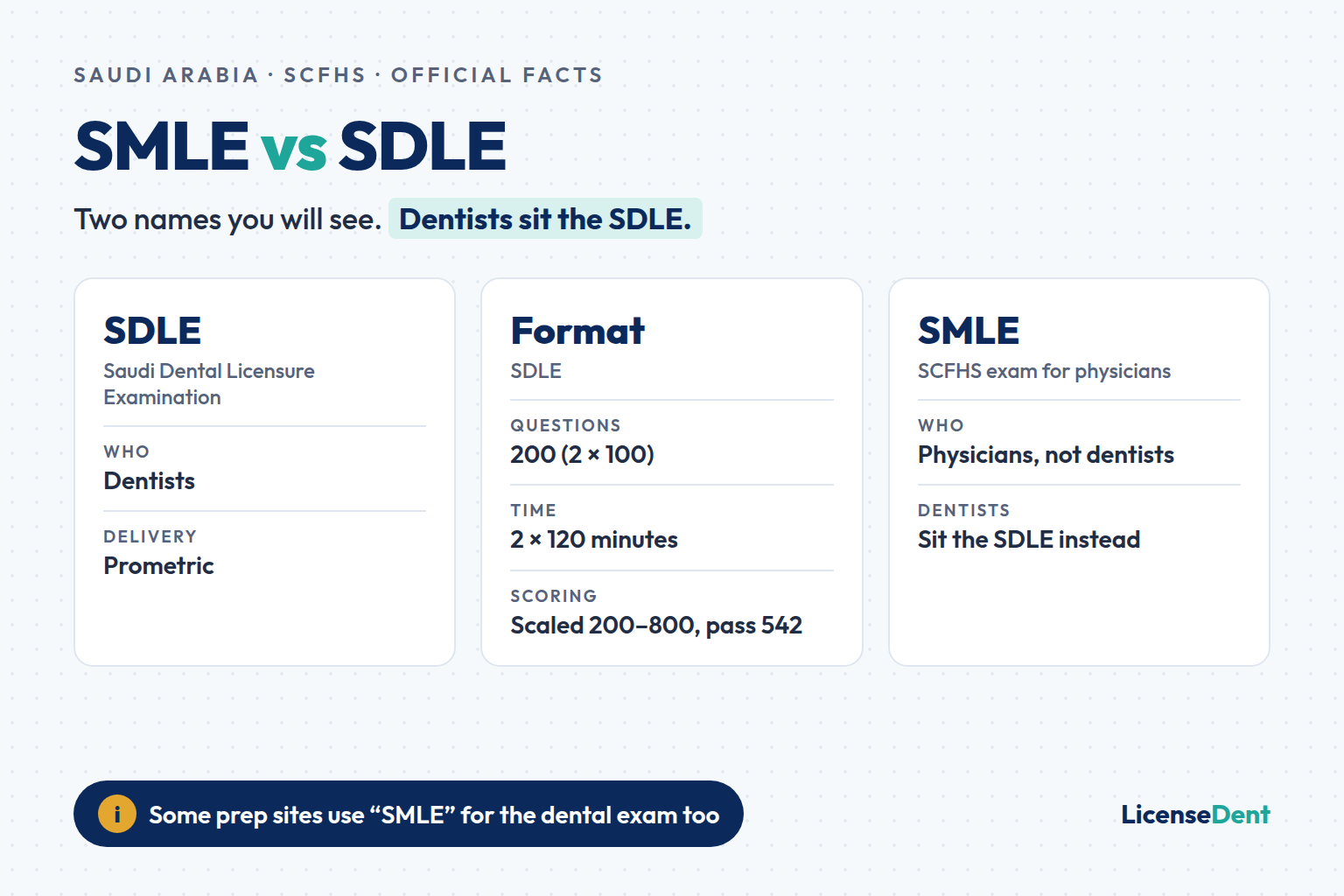
The regulator the Saudi Commission for Health Specialties (SCFHS) officially calls the dental exam the SDLE: the Saudi Dental Licensure Examination. "SMLE" is the broader Saudi Medical Licensing Exam branding used across multiple healthcare professions, and it's carried over onto a lot of exam-prep platforms, including this one's own exam listing, as a catch-all label. For dentistry specifically, the exam you'll actually apply for through SCFHS is named SDLE. If you're searching for official guidance, "SDLE" plus "dental" will get you closer to the primary source than "SMLE" alone.
With the naming sorted, here's what makes the exam itself genuinely different from the rest of the region.
It's scored on a scale, not a percentage
Every other major Gulf dental exam covered on this platform uses a percentage cut score DHA and QCHP both publish 60%, OMSB publishes 65%. SDLE doesn't work that way at all. It uses a scaled score on a 200-800 range, with a passing score of 542, set by a standard-setting exercise involving a panel of Saudi dental experts. There's no percentage to translate this into, and trying to convert it into one will just confuse your own expectations going in 542 out of 800 isn't "68%" in any meaningful sense, since scaled scoring is specifically designed to account for difficulty differences between different versions of the exam.
You can sit it before you've technically graduated
This is arguably the most practically useful difference on this list. SCFHS's own eligibility criteria explicitly include candidates who are still in their internship year, or final-year students who are one year from graduation not just dentists who already hold a completed degree in hand. Every other Gulf exam covered on this platform assumes you're already a qualified, licensed dentist before you apply. If you're a final-year dental student weighing your options early, Saudi Arabia is the one place in the region where "early" can mean literally before you've finished your degree.
The format: two blocks, not one continuous sitting
SDLE runs as 200 questions split into two blocks of 100, each given 120 minutes, with a scheduled 30-minute break between them a meaningfully different rhythm from DHA's single continuous 150-question, 3-hour session. Both blocks mix straight recall questions with scenario-based ones that test interpretation and clinical decision-making, per SCFHS's own applicant guide.
You can keep testing even after you pass
This is genuinely unique among the exams covered on this platform: once you've achieved a passing score on SDLE, you're eligible for two further attempts specifically to improve your mark not to requalify, since you're already qualified, but to strengthen your position for residency selection, where a higher score can matter competitively even after the pass/fail threshold is already cleared. None of the other Gulf exams on this platform offer anything like this. The overall cap is up to four attempts a year, and you can't sit twice within the same testing window the second attempt in a window is simply invalidated, not scored.
Results take longer than you might expect
Unlike Bahrain's NHRA, which gives you a result the moment you finish, or QCHP, which shows your score right after the exam, SDLE results take two to six weeks to come back, because SCFHS runs a full psychometric analysis after each testing window closes before releasing anything. You'll eventually get two documents: a statement of results, and a separate feedback report comparing your performance against other test-takers useful context that a simple pass/fail doesn't give you.
No DataFlow, and a real practice exam from SCFHS itself
Saudi Arabia sits entirely outside the UAE's DataFlow verification network SCFHS verifies and processes applications independently through its own system, so a DataFlow report from a UAE application carries no weight here, and vice versa. One genuine advantage worth knowing about: SCFHS itself publishes an official SDLE practice test, sampled from the real item bank and matching the actual blueprint. Most Gulf authorities don't offer anything like this directly it's worth working through before paying for third-party question banks.
What the exam actually weighs
SCFHS publishes an exact percentage breakdown by section, which is more precise than most other Gulf authorities disclose: Restorative Dentistry alone accounts for 40% of the exam nearly half followed by Periodontics (18%), Endodontics (17%), Oral Medicine & Surgery (15%) and Orthodontics/Pediatric Dentistry (10%). If your revision time is limited, that weighting alone tells you where to spend the majority of it.
The one real consequence of failing
SCFHS's classification and registration rules apply a real consequence to failing SDLE: a two-year classification consequence dating from your graduation date for candidates who don't pass. This is worth knowing early rather than discovering after a first attempt that didn't go the way you planned it's a good argument for using SCFHS's own practice exam and a properly weighted study plan before your first sitting, rather than treating it as a low-stakes dry run.
Put together: same exam, two names, and a format genuinely different enough from the rest of the Gulf that carrying over assumptions from a DHA-style exam will actively work against you. For how Saudi Arabia fits into the wider regional picture including which other Gulf exams require DataFlow and which don't see our Gulf dental licensing exams guide and DataFlow Verification, Exam by Exam.
Sourced from SCFHS's official Saudi Dental Licensure Examination (SDLE) Applicant Guide, 2026-03 edition. Requirements and scoring standards are set by SCFHS and can change always confirm current details on SCFHS's own portal before applying.